


At the time of the Reformation many people began to break away from the Church of Rome because of all the corruption that had gradually begun to creep in. Over the years since many wrongs in the Roman Church have been put right; but at the time it was a very necessary step to reform the church. In Scotland one of the things done in the Reformation was to rearrange the way in which the church was governed. It was decided that instead of having bishops ruling over a number of churches the minister and an elder from each church would represent their own church in a meeting together called a Presbytery. In England however they decided to keep the system of bishops and prayer book.
Everything went well until the king decided he wanted the system of church government and worship in Scotland to be the same as in England. It was in St Giles Cathedral when an attempt was made to impose the English prayer book that the famous Jenny Geddes stood up and threw her stool at the dean in protest. And shortly after this churchmen in Scotland decided it was time to do something to protect their way of worship. They decided to band themselves together to resist the attempt to impose the episcopal system on Scotland. So it was they devised the National Covenant. A covenant is an agreement and those who signed it promised to adhere to and defend their presbyterian way of worship. In 1638 in Greyfriars Church in Edinburgh ministers, lairds, noblemen and commoners signed the Covenant; and soon it was being signed in kirks the length and breadth of Scotland. Those who signed it called themselves Covenanters, pledging themselves to keep the Covenant and to resist any attempt to impose episcopacy on Scotland. Their zeal won the day in the ensuing conflict with Charles I. In the following years of continuing conflict and civil war the Covenanting cause had its high points and its low points, when some of their number were guilty themselves of persecuting those of different persuasions.
In 1662 however after the Restoration Charles II sought to establish episcopacy once again, and as a result about 300 ministers and their congregations were forced to leave their churches, many of them here in south-west Scotland. The minister of Balmaghie was among that number. They stuck firmly to the Covenant and refused to accept the episcopal system. Nor were they willing to accept the king as head of the church, as they declared that this position belonged to Jesus Christ alone. Their allegiance was first and foremost to Jesus Christ and no other could supplant him. By law any person between the ages of sixteen and sixty who refused to attend the reintroduced Prayer Book services, at which roll-calls were taken, had to pay a heavy fine, the money to be collected by soldiers billeted locally. Rather than obey, confirmed Presbyterians escaped into the surrounding countryside, living rough, secretly nurtured by sympathisers, and holding open-air services or conventicles in quiet places in the hills, by burns, or up on the moors.
Harsh measures were taken against the Covenanters and their sympathisers. Not only that, but if they couldn’t pay their fine at once their goods or livestock were seized or they had soldiers billeted on them to eat them out of house and home. They had to put up with all manner of indignities. On the whole the Covenanters sought to offer peaceful resistance and to avoid as far as possible the shedding of blood. But almost inevitably in the face of such severe persecution there were some who became so incensed at the injustices meted out that they responded more forcefully.
Sir Robert Grierson of Lag was one of the most feared persecutors of the Covenanters. In 1678 he was appointed Deputy Steward of Kirkcudbrightshire and the Earldom of Nithsdale. He was unrelenting in his search for non-conformists, hunting down and murdering a large number of Covenanters in the district.
On the 19th February 1685 he was travelling from Wigtownshire to the town of Dumfries escorted by two units of the King’s soldiers – a troop of Claverhouse’s Horse and another of Strachan’s Dragoons, both under the command of Colonel Douglas of Morton. Lag had been collecting taxes and fines on behalf of his new master King James VII, the Roman Catholic brother of the late King Charles II. They stopped at the alehouse in Gatehouse of Fleet for refreshments. It was approaching sunset when the party was ready to remount and continue their journey. As they traversed Irelandton Moor a thick fog descended and that, coupled with the fact that they had imbibed ale rather too liberally at their last stop, caused them to lose their way on the moor. Lag was about to send one of the more sober dragoons back to Gatehouse to procure a guide when a light was spotted through the murk.
They had stumbled upon the farm of Gordoncairn. They enquired of the elderly farmer Gabriel Rain if they were on the right road for Dumfries. He replied that they were well off it. Lag ordered him to guide them back onto the correct path and, somewhat reluctantly, he agreed. After a while they came to Calfarran where the old man told them they would find a younger and much fitter guide. He took his leave of them and set out back to Gordoncairn through the fog.
Without ceremony Lag charged into the house of Thomas Clinton, who was sitting at his hearthside surrounded by his family. Clinton was by inclination a Covenanter and had no love for the military and their bluster. Although not one of the more extremist of the Brethren and not being numbered amongst those who were outlawed or wanted for treason, he couldn’t resist goading Lag for his practices. This only served to get Lag’s back up and he began to question Clinton as to the movements and habits of his neighbours. He asked if he knew the farm of Mayfield and the man who farmed it, to which Clinton replied that he did, pointing out that it was a difficult place to get to. Lag decided that he would go there immediately, even though night had fallen, but Clinton refused to guide him blaming the inclement weather and the treacherous nature of the ground leading to the place. Lag then accused Clinton of being a Covenanter and told him that if we would not do as he was bade then there was a distinct possibility that he would entertain the troops by dancing on the end of a rope before the night was over. Clinton realised that he had pushed things too far, and to save his skin he needed to comply with Lag’s request.
Ordered by Lag to lead them to Mayfield, Clinton set out at the head of the band of military, and led them the two miles across the treacherous moss to their goal, the home of David Halliday, a known Covenanter and wanted outlaw whose name appeared high on the Persecutors wanted list of rebels. On the way Clinton was persuaded by a Royalist officer to sing to them and he did so willingly with a lusty voice, some of the still merry soldiers joining him in the chorus. As Clinton had cleverly realised the noise which they made was so great that half the surrounding countryside would have heard them coming. And as the song which they sang was “Awa’, Whigs, awa’” there could be little room for doubt as to who was abroad that night!
On arriving at Mayfield, not surprisingly the house was empty, the front door was open wide, a fire blazed in the hearth and a half-eaten and still warm meal was on the table. It was obvious that Halliday had fled – and not only him, for there was evidence that there had been others with him who had good reason to fear the approach of the Royalists and had fled with him. Lag was furious that his quarry had escaped and rounded on Clinton, blaming him for warning the rebels of the approach of the soldiers. It was pointed out by his soldiers however that it was them who had made him sing in the first place. An argument then ensued and one of the troopers was on the point of killing Clinton when Lag softened and agreed that he had been compelled to sing.
The soldiers made the most of the comfortable quarters which had been left for them and it was decided to delay the pursuit of the rebels until the morning. Clinton made himself useful by finding fodder for the horses and quarters for the troops until they trusted him enough not to bother watching him too closely. At the first opportunity he slipped away and his presence was not missed until it was too late.
The following morning the soldiers were up and saddled early and they set off in the direction of Dumfries in dispersed order. Lag instructed that everyone they met be stopped and questioned, all houses come across on their way searched and all possible hiding places checked out. He knew that the rebels he sought were in the vicinity as it would have been impossible for them to get far during the night. They hadn’t gone far and were crossing Kirkconnel Moor when the fugitives, five in number, were spotted by some of the troops who found them attempting to hide in a rocky outcrop just over the hill from Lairdmannoch Loch. Knowing the uselessness of trying to outrun mounted troops, the Covenanters surrendered to Lag hoping for quarter but not asking any. They were found to be David Halliday from Mayfield, John Bell of Whiteside in the parish of Anwoth, Robert Lennox from Irelandton in Girthon, James Clement and Andrew McRobert. Both Bell and Halliday were wanted rebels with high prices on their heads.
By far the most important of the Covenanters was John Bell. He was the stepson of Lord Kenmure and a man of some substance in the area. He was socially Lag’s equal if not, in fact, his superior and this fact was not lost on the Royalist who was a notorious snob. He and his kind had been pursuing Bell for several years without success. The Covenanter was the proprietor of Whiteside estate in Anwoth parish, and was a man of great prudence and religious scruple. He had been so disgusted at the behaviour of Charles II that he had joined the Rising that ended disastrously in the Battle of Bothwell Bridge. For the next six years he was a wanted fugitive. His home at Whiteside was taken possession of by Graham of Claverhouse and all his horses, furniture and moveables stolen. In 1681 Claverhouse again quartered his dragoons there until all of that year’s fodder had been eaten up by his horses and the sheep eaten by the men. The crops were gifted to the local curate who accepted them with alacrity – a move he was to regret in due course when this greedy act marked him as a collaborator of the Persecutors.
Bell had a number of lucky escapes before he was captured on Kirkconnel Moor. However that day his luck ran out. Knowing full well that Lag intended to kill them, Bell asked for a few minutes to make his peace with his God, but this was refused by the Persecutor even though Colonel Douglas tried to intercede on behalf of the condemned men. Lag swaggered over to John Bell and said to him, “What the Devil! Hae ye not had time enough for preparation since Bothwell!” He took a pistol from his saddle holster and pushed the muzzle right up against Bell’s heart. With a sardonic leer upon his face he pulled the trigger and sped John Bell to his Maker. That was the signal for the butchery of the others to begin, and as they knelt on the ground trying to pray they were massacred alongside him.
Lag forbade the burial of the corpses and they were ordered to be left on view to deter others from supporting the Covenanters.. Eventually their friends were allowed to carry the bodies down to consecrated ground. Bell was buried in Anwoth churchyard, Halliday in Balmaghie, Lennox was buried in Girthon and McRobert in Twynholm. Their headstones can still be seen in those churchyards where they have been carefully and lovingly preserved over the last three hundred years. James Clement was a stranger to the area and he was buried where he fell. ‘Old Mortality’ provided a stone over his grave.
On 11th September 1831 upwards of ten thousand people gathered on the slopes of Kirkconnel Moor to participate in an open air service conducted by Rev John Osbourne in their memory. Soon after a monument was erected paid for by these worshippers. Plaques on each face of the monument record the names of the martyrs, and also details of later conventicles held at the site. The main plaque has the following words:
In testimony
Of the feelings of the present generation
On the 11th September, 1831
about ten thousand persons assembled here,
and after hearing an excellent sermon,
preached by the
Revd John Osborne
From Psalm 74, verse 22nd
Contributed a fund, for the erection
of this monument
To the memory of these martyrs.
(Alexander Murray Esq. of Broughton
having handsomely given the ground)
Four of whom were carried to their respective
burial places, but James Clement,
being a stranger, was interred in this spot.


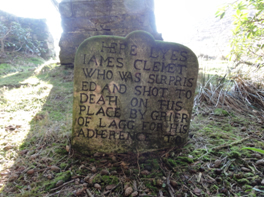
David Halliday’s gravestone in Balmaghie churchyard records:

Here Lyes David Halliday Portioner of Meifield Who Was Shot Upon 21 of Febr 1685 and of David Halliday Once in Glengape Who Was Likewise Shot Upon the 11 of Juny 1685 For Their Adherence to the Principles of Scotland’s Reformations.
Beneath This Stone Two David Hallidays
Doe Ly Whose Souls Nou Sing Their Masters Praise
To Knou If Curious Passengers Desyre
For What By Whome And Hou They Did Expyre
They Did Oppose This Nation’s Perjurey
Nor Could They Joyn With Lordly Prelacy
Indulging Favours From Christ’s Enemies
Quench’d Not Their Zeal This Monument Then Cryes
These Were The Causes Not To Be Forgot
Why They By Lag So Wickedly Were Shot
One Name One Cause One Grave One Heaven Do Ty
Their Souls To That One God Eternally.
The stone makes clear that a second martyred David Halliday lies buried in Balmaghie churchyard. On 11th July 1685, Lag and the Earl of Annandale were in command of a troop of dragoons in the parish of Twynholm. At night as they were riding back to their base they came upon two Covenanters, David Halliday and George Short. Realising they had no chance of escape, they gave themselves up. Annandale decided they should be taken prisoner and face trial the next day. However Lag ordered that the pair should be shot as they lay tied up
on the ground. At first the soldiers refused, but when Lag threatened them with the consequences if he was forced to do the deed himself, they pulled their guns and fired.
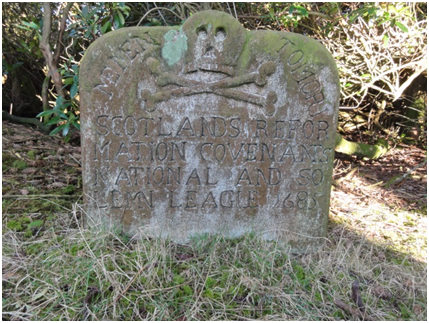
The corpses were left where they fell, but were later taken to Balmaghie Kirkyard, where they lie in separate graves. As mentioned above, David Halliday is buried alongside his namesake who had already been martyred on 21st February 1685 at Kirkconnel Moor. George Short is buried in a separate grave, over which a stone has been raised with the words:
HERE LYES GEORGE SHORT
WHO WAS PURSUED AND TAKEN
AND INSTANTLY SHOT TO DEATH
UNDER CLOUD OF NIGHT
IN THE PARISH OF TONGUELAND
BY GRIER OF LAG
MEMENTO MORI
AND THE EARLE OF ANNANDALE
BECAUSE OF HIS ADHERENCE
TO SCOTLANDS REFORMATION
COVENANTS NATIONAL AND
SOLEMN LEAGUE 1685


After the time of the Covenanters Balmaghie continued to be a centre of radical Presbyterianism on account of its parish minister, Rev John MacMillan. He was ordained to the parish on 18th September 1701. In 1702 the Synod of Galloway requested ministers to explain the National Covenant of 1638 to their congregations, which John MacMillan did; but he also explained to them the nature and objectives of the Solemn League and Covenant of 1643. The distinction he made was that the National Covenant was intended to counter Popery while the Solemn League and Covenant was of wider scope being for religion, king and the `peace and safety` of the three kingdoms. He was opposed in principle to the Revolution Settlement of 1690 because, in spite of Presbyterianism being the religion of Scotland, there was still prelacy in England and Ireland, and Catholicism was granted considerable toleration. In Scotland the General Assembly could not meet without royal approval. This situation was not what the hardened Covenanters thought was right and was the reason for MacMillan`s stand. In July 1703 he petitioned the Presbytery to assert the Divine Right of Presbyterian Church Government – the right of the Church courts to manage their own affairs and the Headship of Christ over the Church.
The fall out from the Glorious Revolution had hardly settled before King William III died on 8 March 1702. This left Queen Anne on the throne and raised the hopes of the Jacobites and ushered in yet another round of civil interference in the Presbyterian church. This began with a letter to the General Assembly from the Queen in 1703 which seemed to deny that the scriptures underpinned Presbyterianism and the way it was organised in church courts. The Assembly replied that Presbyterianism was agreeable to the Word of God and most conducive to the advancement of true religion and godliness. Later, while in session reviewing the actions of the Synods and about to approve them, the Queen`s Commissioner, Lord Seaforth abruptly dissolved the Assembly. As one would expect, this attempt to control the proceedings of the courts of the Church caused alarm among the earnest evangelical ministers such as John MacMillan.
The Presbytery were not of such stern stuff and sought to get John MacMillan to withdraw his petition; and when he would not, they appointed a visitation of his congregation to take place on 30th December 1703. The purpose of this visit was not a visitation in the normal sense, but to charge him with libel and following divisive policies. MacMillan did not know of the action but when the charge was passed to the Presbytery officer to be read out, he got hold of it, read it to his audience and demanded that they produce evidence if they had any. None was forthcoming and the meeting eventually broke up with MacMillan continuing to defy the visitation members.
There then followed an underhand act, where some members went to the neighbouring Crossmichael church, reconvened the meeting of the Presbytery and deposed MacMillan from his ministry. That they did this without summoning him before the meeting was completely illegal and was seen by MacMillan as evidence of a new Moderatism creeping into the Church. He however responded to the Presbytery with apologies and remained silent for about a year; eventually, despairing of getting any redress, he stood up after the sermon one Sabbath and declared that he would preach the following week.
From then on, for some 26 years he ministered within the parish simply ignoring the committee and its ruling, and continuing to preach and live in the manse. Notably, the congregation stayed with him and when a new minister was sought to replace MacMillan in 1710 only 9 parishioners signed his call – some 87 heads of households and young men protested against the appointment. During this time he also married Mary Gordon, daughter of the well-known Covenanter Sir Alexander Gordon of Earlstoun.
Shortly after his deposition the General Meeting of the Societies, the Cameronians, invited him to a meeting which he attended. Several more meetings took place and on 10 October 1706 he received a call to be their minister. Macmillan saw where his duty lay and on December 2nd 1706 he began by preaching at Crawfordjohn. Although the members of the Society were widely scattered MacMillan visited them regularly, but the widespread nature of his new parish that stretched from Galloway to Fife eventually caused him to leave Balmaghie in 1727.