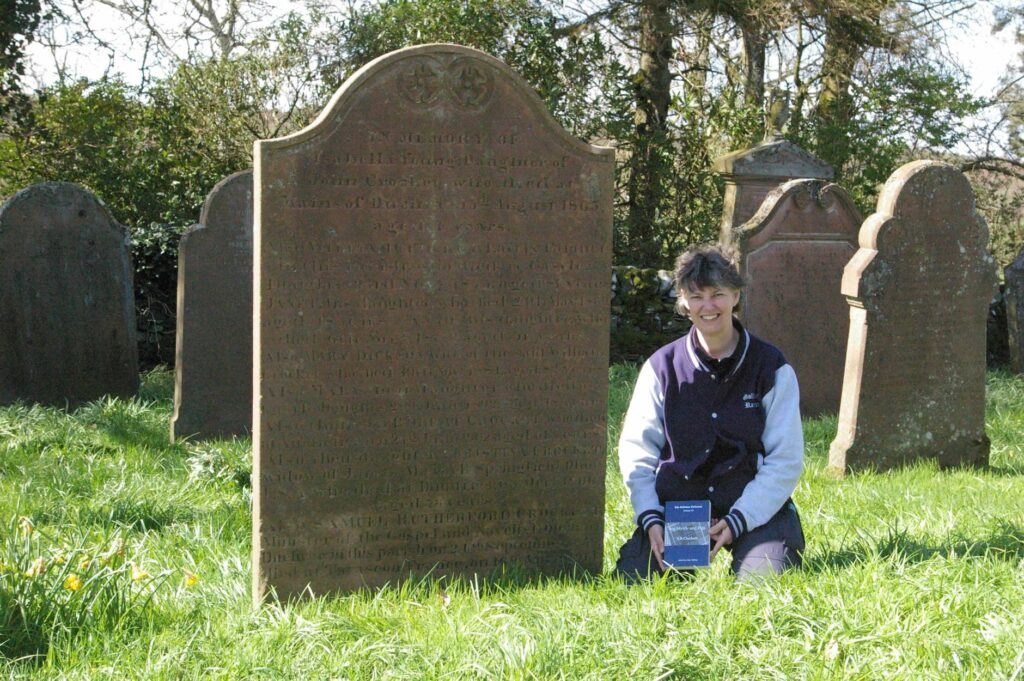
Saturday 16th April marks the anniversary of Samuel Rutherford Crockett’s death who was buried at Balmaghie Kirk on the 24th of April 1914. Read about Crockett’s funeral and find out more about the author and his novels in this short piece by Cally Phillips, founder of Galloway Raiders https://www.gallowayraiders.co.uk/
‘For of all those who were a part of these things, only one now remains upon the earth. The rest are over the hill yonder, in the Balmaghie kirkyard, the sweetest and the sunniest God’s Acre in Scotland, and since such things must needs be, doubtless a right desirable place for any tired wanderer’s resting-grave.’
S R Crockett
Buried Balmaghie Kirk Yard 24th April 1914
We need to talk about Crockett!
Samuel Rutherford Crockett died in Tarascon, France on April 16th 1914. His body was
repatriated and buried at Balmaghie Kirk on April 24th, 1914. The Scotsman Newspaper
reported the event: ‘In an introduction to ‘The Kirk Above Dee Water’ by the Rev
H.M.B.Reid (now Professor Reid of Glasgow University) the late Mr S.R.Crockett wrote
that when the time came when the Galloway requiem ‘Sae he’s won awa’’ should be said
of him, it was in Balmaghie kirkyard he should like to lie ‘among the dear and simple folk I
knew and loved in youth.’ His wish was fulfilled and there he was laid to rest yesterday in
the churchyard overlooking the Dee, the river he made so famous.
The funeral procession left Castle Douglas Station to which the remains had been taken
direct from London, at half past one o’clock, and in the streets through which it passed
there was large numbers of people, to many of whom doubtless, the novelist was known in
his early years, when Castle Douglas was his home. The cortege having traversed the
four miles between the town and the church of Balmaghie, a simple service was held
within the unpretentious building. The ministers taking part were the Rev. W.A.Mowat
parish minister; the Rev A.B.Craigh, United Free Church, Laurieston, and the Rev J.
Mitchell St Andrew’s United Free church, Peebles (the congregation of which Mr Crockett
was a member). At the close the mourners, reverently standing, heard the Dead march in
‘Saul’ played by the organist and the body was then borne to its last resting place.
The pall bearers were Mr Philip Crockett (son) Mr Samuel Crockett (cousin) Mr John Oliver
(nephew) Mr William Sproat (brother in law) Mr Malcom McL Harper, Mr Andrew C.
Penman, Mr John Maclellan and the Rev A.B.Craig. Mrs Crockett and her two daughters
and her niece Miss Gunn, Edinburgh, were also present.
Mr Craig conducted the brief graveside service and Mr Philip Crockett in a few words
thanked the company for the respect they had paid to his father’s memory.
Professor Reid, Glasgow, was prevented by unavoidable duties from being present.
Crockett never forgot the Balmaghie folk of his youth. He wrote about them and about the
Balmaghie landscape extensively – you might say warts and all. In The Standard Bearer
(1898) his narrator humorously states: ‘There’s as many minds in Balmaghie as there’s
folks in it.’ This is the kind of observation only a native born in the parish could get away
with!
A bestseller in his lifetime, but long since out of fashion, the Glenkens stands proudly at
the heart of a re-awakening awareness of the man and his works. Crockett was always a
champion of the underdog. Ironic then, that posthumously he should fall victim to the ‘give
a dog a bad name’ cliché. The (mis)application of the label ‘kailyard’ has been unfairly
punishing and for too long deprived Scots of the chance to engage with one of this
country’s finest storytellers. Indeed the kailyard critique is no more than a sign of
ignorance of Crockett’s work in the context of his own and subsequent times. It is most
often proffered by those who have barely read his works. Those who come to Crockett (as
I did a quarter of a century ago now) fresh, with no preconceptions, generally find him
funny, skilful and above all a master of close observation of both people and places. And
he takes no prisoners in terms of exposing hypocrisy. It is no coincidence that the very
types of people he lampoons in his work are the ones who continue to discredit his writing.
His appeal to ‘dear and simple folk’ is still great.
Admittedly in the 21st century many people don’t have the time or inclination to read long
novels. But if you are a reader, there’s a real treat in store. As of April 16th 2022 the
‘Complete Crockett’ works are available for FREE download in PDF format, HERE.
If you want to dip your toe in first, or don’t know where to start, The Galloway Raiders
website (and the S.R.Crockett archive ) have a wealth of information, including some
themed areas, which can work as a gateway into Crockett’s ‘world’ and its Galloway
heartland. As an (unofficial) part of Scotland’s Year of Stories 2022 you can listen to
readings of short stories and chapters from his work on YouTube or HERE. A series of
themed blog posts is running monthly on the GGLP website and the April one features
Balmaghie HERE.
Crockett held Balmaghie dear to him and never forgot his roots. So it is entirely fitting that
Balmaghie folk should remember him, especially his passing. If you visit Balmaghie Kirk
this Easter, stop a minute at his grave. Then, armed with some of his stories as a guide,
start your own adventure around some of Crockett’s ‘places’ in the Glenkens. It’s the
adventure of a lifetime, believe me!
Cally Phillips
Galloway Raiders
April 2022